Reading Iron and Steel
Viking weaponry was neither crude nor universally uniform. A warrior's arms reflected extreme socio-economic stratification. Metallographic sectioning reveals how blades combined brittle high-carbon cutting edges with resilient low-carbon iron cores, while rare imported crucible steel pushed metallurgical boundaries centuries ahead of European domestic craft.
The Inscribed +VLFBERHT+ Swords
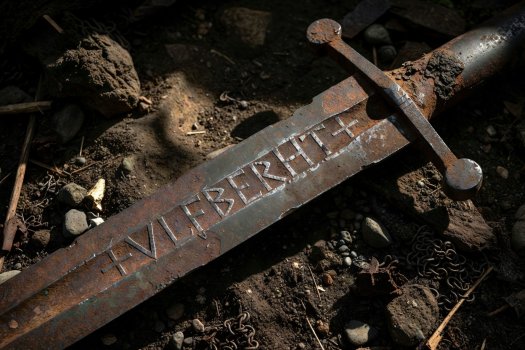
Over 170 swords bearing the signature +VLFBERHT+ have been found across Northern Europe, primarily pulled from riverbeds in Norway, Finland, and the Baltic. Metallurgist Alan Williams demonstrated that true Ulfberht blades possess carbon contents up to 0.8% and virtually zero slag inclusions.
This indicates the use of crucible steel—molten iron heated above 1400°C—a technology not commercially mastered in central Europe until the Industrial Revolution.
The Volga Trade Route & Frankish Monopolies
How did Norse warriors obtain crucible steel? Archaeologists trace raw ingots along the Volga trade route to Central Asia (specifically modern Uzbekistan and Iran), where crucible casting flourished.
Rhineland Frankish workshops likely bought these ingots or forged the blades, strictly stamping their brand mark. In response to rampant Norse smuggling, Carolingian Emperor Charles the Bald banned the export of Frankish swords in 864 CE under penalty of death.
Furthermore, numerous contemporary counterfeits exist (spelled +VLFBERH+T with incorrect cross placement), made of inferior slag-ridden bog iron, proving that brand prestige was exploited in the tenth century.
The Only Surviving Helmet: Gjermundbu
Despite hundreds of Hollywood depictions, only one single authentic Viking Age helmet has ever been excavated in Scandinavia. Uncovered on Gjermundbu farm in Buskerud, Norway in 1943, this ninth-century find defines what defensive headgear actually looked like.
Structure of the Spectacle Helmet
The Gjermundbu helmet was reconstructed from nine corroded iron fragments recovered from a rich cremation mound. It features four iron plates riveted to two crossing reinforcing bands, with an iron peak spike at the apex.
A distinctive "spectacle" guard protects the eyes and bridge of the nose. Small holes along the rim held a mail drape (aventail) protecting the neck. It shows no horns, animal wings, or unnecessary protrusions that would snag weapons.
Why Are Helmets So Rare in the Record?
The absence of helmets in graves is not evidence of unarmored battle. Iron was intensely valuable; worn helmets were melted down, reforged into agricultural scythes, or passed down through generations rather than consigned to grave dirt.
Helmets were exclusively chieftain-tier equipment. The average rank-and-file levyman (leidang) fought in thick layered wool, hardened leather caps, and carried a round wooden lime or pine shield covered in rawhide.
The Universal Weaponry: Axes and Spears
While swords represented aristocratic status, spears and bearded axes won battles on shield-wall frontlines.
The Dane Axe (Broadaxe)
Late 10th - 11th c.Lightweight, wafer-thin iron blades with forge-welded high-carbon steel edges. Mounted on 1.2 to 1.5m ash hafts, capable of cleaving mail and shield bosses with kinetic two-handed leverage.
Winged Spears (Krókspjót)
8th - 11th c.Long socketed spearheads with lateral projection lugs (wings) to prevent over-penetration into victim bodies and to hook enemy shield rims out of formation.