What Viking Finds Reveal—and Legends Hide
Pop culture depicts horned raiders and mythological monocultures. The genuine archaeological ledger tells a more complex story: precision metallurgy, maritime engineering, intercontinental trade networks, and diverse gender roles documented through verified grave goods and physical settlements.
One Find, Several Stories — The Oseberg Ship Phenomenon
Unearthed in Vestfold, Norway in 1904, the Oseberg mound buried an entire 21-meter oak vessel containing two women, elaborate animal-head posts, 14 horses, an ornate timber cart, and textile fragments. For decades early antiquarians assumed a subservient Queen was interred with a sacrificed servant. Modern isotopic, DNA, and osteological analyses have shattered these simplistic Victorian projections.
The Physical Mortuary Chamber
Dendrochronological dating fixes the timber felling to 834 CE. Both women ate marine and terrestrial diets of elite quality; one lived into her late seventies despite severe arthritis and cancer. The sheer concentration of prestige carved wood demonstrates monumental burial wealth invested exclusively in female leadership.

The Oseberg headposts, carved with gripping-beast patterns, show tool wear indicating master workshop specialization long before urban centres were thought to exist in Scandinavia.
Reassessing Authority in the Viking Age
Rather than passive symbols, the deceased held ceremonial, political, or sacral roles that dictated huge community labor investments. Silk remnants woven with Persian motifs prove direct or secondary commercial contact with the Abbasid Caliphate prior to mid-ninth-century Baltic consolidation.
Contemporary archaeology uses microstratigraphy and organic residues to distinguish between religious functionaries (völvur) and dynastic matriarchs, confirming that political authority in ninth-century Scandinavia was not strictly patriarchal.
Iron, Timber and Burial Earth — Four Pathways
We organize genuine Viking Age discoveries across four tangible materials and contexts, rejecting modern romanticism in favor of stratigraphic field data.
Lives Recorded in Graves
Burials & SkeletonsFrom the weapon-bearing female of Birka Grave Bj 581 to the mass executed bodies at Ridgeway Hill, bioarchaeology tracks health, trauma, migration, and ritual expenditure.
Reading Iron and Steel
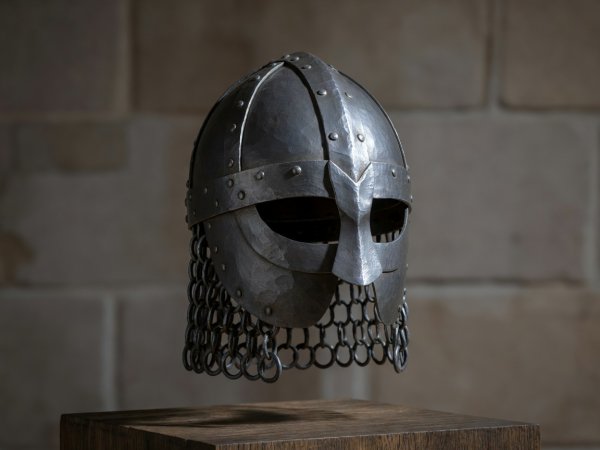
Weapons & ArmorPattern-welded blades, Ulfberht crucible-steel trademarks, the singular Gjermundbu spectacle helmet, and heavy bearded axes analyzed through metallography.
Hulls That Changed Horizons
Nautical ArchitectureClinker-built keels, tarred animal hair caulking, Gokstad's sea-going lines, and the Skuldelev blockades of Roskilde Fjord revealing specialized war and cargo vessels.
Traces of Everyday Worlds
Settlements & TradeThe turf-walled halls of L'Anse aux Meadows in Newfoundland, the dense workshops of Jorvik (York), and the longhouse complexes at Hedeby and Kaupang.
Put the Evidence in Order — Chronology of Major Discoveries
Physical artefacts do not appear in isolation. Stratigraphy and dendrochronology anchor excavated discoveries along an unbroken chronological chain across four centuries.
The Salme Ship Burials (Saaremaa, Estonia)
Two pre-Viking clinker-built boats unearthed on Saaremaa containing over 40 Scandinavian warriors buried with gaming pieces, swords, and birds of prey. The earliest direct archaeological proof of organized trans-Baltic amphibious warfare.
The Oseberg Ship Entombment (Tønsberg, Norway)
Luxurious yacht buried beneath blue clay and turf for two elite Norse women. Contains unparalleled surviving ninth-century textiles, wooden animal-head posts, and culinary provisions.
The Gokstad Vessel & Sea-Keeping Mastery (Sandefjord, Norway)
Robust ocean-going longship burial of a powerful chieftain. Demonstrates mature mast-step engineering, 64 wooden shields, and 16 pairs of oar ports equipped with sliding shutters.
Gjermundbu Chieftain's Armory (Buskerud, Norway)
Cremation mound yielding the only preserved Scandinavian Viking helmet in existence, along with a complete mail shirt, pattern-welded sword, and riding equipment.
L'Anse aux Meadows Norse Encampment (Newfoundland, Canada)
Absolute dating confirmed via solar cosmic-ray ring spikes (993 CE anomaly) proving European tree felling and iron smelting on the North American continent exactly five centuries before Columbus.
Where Legend Outruns the Record — Archaeological Discrepancies
Popular perceptions of Norse culture rely largely on thirteenth-century Icelandic sagas and Victorian romantic revivalists. Physical earthworks tell an austere, distinct truth:
Horned Helmets Do Not Exist
Across thousands of surveyed graves and settlement layers in Scandinavia, Britain, Ireland, and Rus territory, not a single horned helmet has ever been discovered. The Gjermundbu find features smooth rounded steel designed to deflect downward sword strokes. Horns would catch blade edges and break the warrior's neck.
1876 Wagnerian Costumes
Costume designer Carl Emil Doepler introduced horned headgear for the 1876 Bayreuth premiere of Wagner’s Der Ring des Nibelungen. Victorian antiquarians uncritically blended Bronze Age ritual ceremonial finds (like the Veksø helmets, cast 1,500 years before the Viking Age) with early medieval Scandinavia.
Hygiene Implements Outnumber Weapons
Bone combs, ear-spoons, tweezers, wash-basins, and soapstones represent the single most ubiquitous domestic finds in urban deposits at Dublin, York, and Hedeby. Skeletons demonstrate careful grooming and tooth hygiene.
Monastic Chronicle Biases
Clerical victims of coastal raids (such as Alcuin at Lindisfarne, 793 CE) framed Norsemen as sub-human, savage fiends driven purely by bloodlust, deliberately erasing their sophisticated urban craft, trading agreements, and domestic habits.
Ask the Archaeological Question — FAQ Preview
Curious about DNA, female warriors, Ulfberht swords, or carbon dating? Check the core questions answered by field researchers:
Was Birka grave Bj 581 truly a female high-ranking warrior?
How do archaeologists know the exact year Vikings were in North America?
The Reason for This Ledger — Editorial Approach
Bopstvikingpand was built as a clean, independent digital repository for students, educators, and historical enthusiasts who demand archaeology over fantasy. We catalog material culture exactly as it emerges from the trench: measured by total weight, dendrochronological ring matches, isotope signatures, and excavation stratigraphy.
Have you analyzed an excavation report or noticed a discrepancy in a catalogued artifact? You can submit an academic query or revision notice directly through our message ledger.