Traces of Everyday Worlds
Beneath the headlines of longships and swords lay an agrarian, mercantile civilisation anchored in peat, timber, animal husbandry, and urban workshops. From the anaerobic mud of Anglo-Scandinavian York to the turf sod walls of Newfoundland, settlement archaeology illuminates how regular Norse families lived, traded, ate, and survived.
L'Anse aux Meadows (Newfoundland)
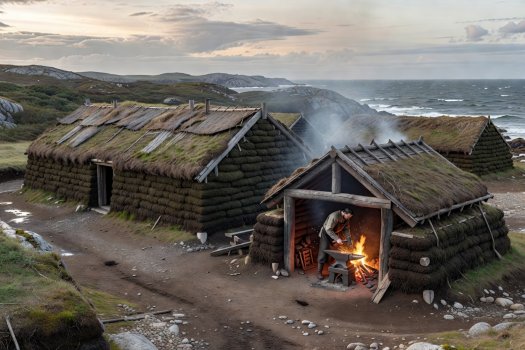
Discovered in 1960 by Helge and Anne Stine Ingstad at Epaves Bay, northern Newfoundland. The site contains eight sod buildings comprising three timber-framed residential halls, living huts, and an iron bloomery forge.
Excavations recovered a bronze ring-headed cloak pin of Norse-Irish type, a bone needle, carved birch bark, ship boat rivets, and worked butternuts (juglans cinerea), which do not grow north of the St. Lawrence River, confirming Norse exploration further south into coastal New England.
The Cosmic Ray Milestone: 1021 CE
For sixty years, radiocarbon dating could only provide a broad range of 990–1050 CE. In 2021, Margot Kuitems and Michael Dee utilized the Miyake solar-storm spike—an abrupt increase in atmospheric radiocarbon recorded across the globe in 993 CE.
Analyzing three separate pieces of fir and juniper wood showing clear metal axe chop marks, they pinpointed the exact year of the tree felling to 1021 CE. This marks the earliest scientifically indisputable date for European presence in the Americas, exactly one thousand years before the study.
The Urban Workshop Hub: Coppergate, York
Between 1976 and 1981, York Archaeological Trust excavated 9 meters of waterlogged deposits in central York (Jórvík). The lack of oxygen preserved over 40,000 perishable organic artefacts dating from the late 9th and 10th centuries.
Craft Specialisation in Wattle Halls
Archaeologists unearthed two-story sunken-featured wattle-and-daub workshops facing paved timber alleys. Distinct tenements specialized in:
- Antler and bone comb-carving with steel saw templates.
- Shoemaking using vegetable-tanned cowhide with ankle toggles.
- Wood turning with pole lathes producing thousands of ash bowls.
- Dyeing textiles with imported madder and woad roots.
Dietary and Parasitological Evidence
Coprolites (fossilized human feces) such as the Lloyd's Bank coprolite revealed a diet dominated by coarse wholemeal bran bread, smoked herring, wild blackberries, and hazelnut shells.
Sediment samples showed heavy infestations of intestinal whipworms (Trichuris trichiura) and maw-worms. Urban life in Scandinavian York was bustling, highly commercial, and cosmopolitan, but sanitary challenges affected health.
The Great Nordic Market Network
Long before nation-states formed, trading ports connected the North Sea to the Silk Road through silver bullion hacksilver and coin weights.
Hedeby (Haithabu)
Schleswig, GermanyEnclosed by the semi-circular Danevirke rampart, Hedeby handled transit between the Baltic and North Sea, avoiding dangerous storms around Jutland.
Kaupang in Skiringssal
Vestfold, NorwayNorway's earliest seasonal trading hub (c. 800 CE). Excavations yielded raw amber from the Baltic, Frankish glassware, and Anglo-Saxon silver penny hoards.
Gnezdovo & Novgorod
Dnieper River, Eastern RouteVarangian river fortifications where Scandinavian traders bartered furs, slaves, and amber for Byzantine silk and thousands of silver Islamic dirhams.