Hulls That Changed Horizons
The rapid expansion of the Scandinavian diaspora between the eighth and eleventh centuries was, above all, a hydrodynamic revolution. The clinker-built hull—overlapping radial-split oak strakes held by clench rivets—produced an elastic, featherweight hull capable of twisting through open Atlantic swells without shattering rigid joints.
The Gokstad Ocean Cruiser
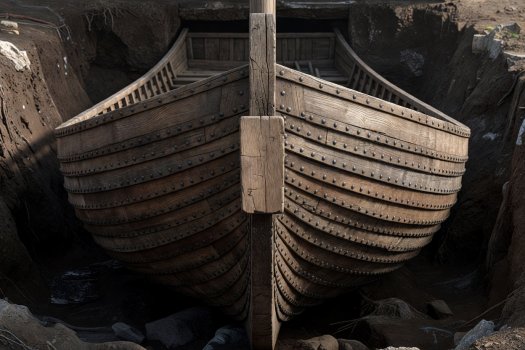
Excavated in 1880 in Sandefjord, Norway, the Gokstad ship measures 23.8 meters in length with a beam of 5.1 meters. Built almost entirely of mature oak felled circa 890 CE, it displaced roughly 20 tons with a shallow draft of barely 1 meter.
Planks below the waterline were not nailed to the internal ribs; they were lashed with spruce roots through raised cleats carved out of the plank wood itself. This ingenious floating design enabled the hull to flex over oceanic waves rather than fight their immense hydrostatic pressure.
The 1893 Atlantic Crossing Test
In 1893, Captain Magnus Andersen constructed an exact full-scale replica named Viking and sailed her from Bergen to the World's Columbian Exposition in Chicago across the tempestuous North Atlantic.
Andersen reported that the gunwales yielded up to 15 centimeters in heavy seas, and the side rudder (steerboard) functioned with effortless balance in the highest gale. The ship averaged 10 to 11 knots under a single square wool sail, proving beyond doubt that Ninth-century Norse naval architecture possessed genuine trans-oceanic competence.
Vessel Specialization: The Skuldelev Wrecks
In 1962, underwater archaeologists at Roskilde Fjord, Denmark, raised five intentionally scuttled ships that had blocked the channel circa 1070 CE. The Skuldelev discovery decisively debunked the notion of a single universal "Viking longship."
Skuldelev 2: The Great Sea-Dragon
A 30-meter warship (skeid) built of oak felled near Dublin, Ireland in 1042 CE. Designed for a crew of 65 to 70 warriors pulling 30 pairs of oars. It had almost zero cargo space, optimized exclusively for tactical troop delivery across coastal shallows.
Skuldelev 1: The Ocean Knarr
A 16-meter deep-bellied cargo vessel built of pine from western Norway. It had high freeboard, only two to four oar ports for harbour maneuvering, and relied entirely on a massive square sail to carry up to 24 tons of walrus ivory, timber, and livestock across the North Atlantic to Iceland and Greenland.
Ship Typology & Engineering Matrix
| Vessel Name | Class | Dimensions | Oak/Timber Provenance | Primary Operational Function |
|---|---|---|---|---|
| Oseberg | Karvi (Elite Coastal) | 21.5m x 5.1m | Vestfold, Norway (820 CE) | Ceremonial transport, sheltered fjord cruising, burial monument |
| Gokstad | Karvi/Leidang Warship | 23.8m x 5.1m | Vestfold, Norway (890 CE) | Open ocean raiding, high-speed sea travel, chieftain fleet flagship |
| Skuldelev 1 | Knarr (Deep Freighter) | 16.0m x 4.8m | Sogn, Norway (1030 CE) | Bulk ocean freight, colonization voyages to Iceland & Greenland |
| Skuldelev 2 | Skeid (Long Warship) | 30.0m x 3.8m | Dublin, Ireland (1042 CE) | Mass tactical raiding, swift troop deployment along river networks |
| Skuldelev 3 | Byrding (Coastal Trader) | 14.0m x 3.3m | Roskilde, Denmark (1040 CE) | Baltic market trade, transport of grain, soapstone, and raw furs |