Lives Recorded in Graves
Burial customs across Scandinavia were deeply heterogeneous. Cremation pyres, stone ship-settings, deep turf mounds, and rock-cut chamber graves reveal that social status, kinship, spiritual affiliations, and regional customs dictated the treatment of the dead rather than a uniform "Viking" funerary rite.
The Birka Chamber Tomb (Bj 581)
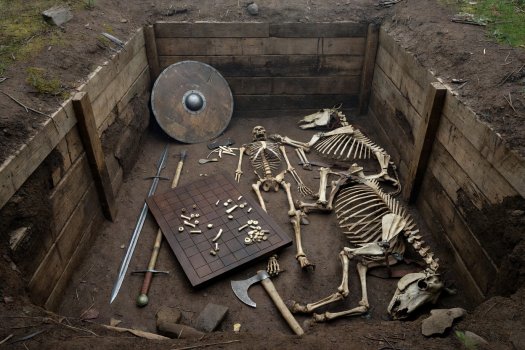
Excavated in 1878 by Hjalmar Stolpe on the island of Björkö in Lake Mälaren, Sweden. The stone chamber contained an adult skeleton alongside a sword, seax, battle knife, two lances, two shields, 25 armor-piercing arrowheads, two slaughtered horses placed on an elevated platform, and an intact gaming board with 28 markers.
For more than a century, 19th-century scholars labeled this individual as the quintessential male Viking military leader based entirely on the weapon assemblage.
Genomic & Osteological Reassessment
In 2017, a research team from Stockholm University and Uppsala University performed nuclear genomic sequencing on tooth root and humerus samples. The results were conclusive: the individual lacked a Y-chromosome and possessed two X-chromosomes.
Strontium isotope testing verified non-local mobility during youth, indicating migration to Birka. The inclusion of a hnefatafl board suggests strategic operational planning rather than mere ceremonial symbolism.
Archaeological Note: Scholars caution against automatically retrofitting modern notions of female warrior "shield-maidens" onto this find. While she was undoubtedly buried with full martial leadership honors, her biological sex demonstrates that high-tier combat commands in tenth-century Scandinavia were accessible across binary gender divides.
Violent Realities: Ridgeway Hill Mass Grave
Not all burials were celebratory monuments. In 2009, highway construction workers in Dorset, England, uncovered a catastrophic pit containing 54 decapitated skeletons and 51 detached skulls piled neatly in a separate cluster.
Forensic Examination of Ridgeway Hill
Radiocarbon dating establishes that the killings occurred between 970 and 1025 CE, directly coinciding with the renewed Danish raids led by King Sweyn Forkbeard.
Osteological analysis reveals that the victims were healthy young males between 18 and 25 years old. Deep, unhealed defensive wounds mark the arms and shoulders. Multiple blows to the neck and face demonstrate that decapitation was carried out from the front while the prisoners were restrained, forced to look their executioners in the eyes.
Isotopic Origins of the Executed Crew
Oxygen and strontium isotopes extracted from dental enamel proved the victims were not local Anglo-Saxon soldiers. Their tooth enamel reflected childhood drinking water from sub-Arctic climates, specifically western Norway, northern Sweden, and the Baltic coast.
This discovery provides the first physical evidence of a complete Viking raiding crew being captured, stripped of armor, and methodically executed in mass by defending Anglo-Saxon militias, contradicting romantic myths of invincible invulnerability.
Comparative Mortuary Ledger
Key verified Viking Age burial excavations and their diagnostic characteristics:
| Burial Site | Location | Date | Interred Demographics | Key Grave Goods |
|---|---|---|---|---|
| Oseberg Mound | Vestfold, Norway | 834 CE | 2 elite women | Full 21m oak ship, 14 horses, ornate cart, 4 sledges, tapestries |
| Gokstad Mound | Sandefjord, Norway | c. 890 CE | 1 adult male (tall, muscular) | Fast ocean longship, 64 shields, 12 horses, 6 dogs, peacock |
| Birka Bj 581 | Uppland, Sweden | c. 950 CE | 1 female leader (XX DNA) | Sword, seax, 2 spears, bow, 2 horses, hnefatafl tactic board |
| Salme I & II | Saaremaa, Estonia | c. 750 CE | 41 Scandinavian men | Clinker boats, gaming pieces, double-edged swords, hunting birds |
| Ridgeway Hill | Dorset, England | c. 1000 CE | 54 decapitated crewmen | No weapons (stripped prisoners), execution cuts, skull mounds |